Architecture
MedOmni v0.3.0 in five views:
- the repository layout
- who uses it (C4 C1)
- its containers (C2)
- the components inside the
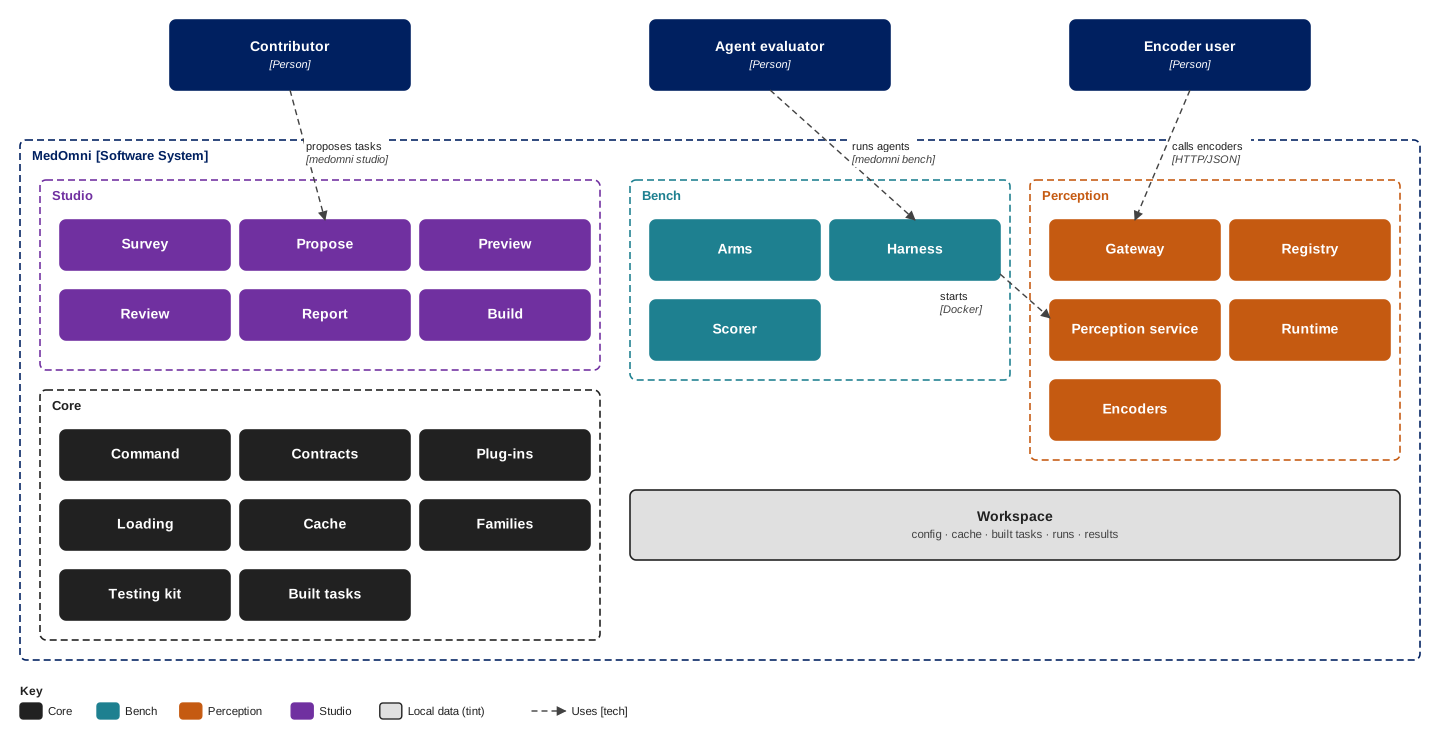
medomnipackage (C3) - C1 to C3 nested in one picture
Repository layout
The repository holds one package, medomni: Core and three projects. Code is under src/; content that people write and review (families, dataset packages, task templates, cohorts, benchmarks, agent configs, encoders) is in one top-level folder per project. The starting files that each new command writes are inside the package.
MedOmni/
├── src/medomni/
│   ├── core/                 medomni.core
│   │   ├── cli/              the medomni command
│   │   ├── contracts/        typed models, validators, schemas/
│   │   ├── plugins/          entry-point loading
│   │   ├── loading/          format readers (CSV, OMOP, folder trees, recording headers) and the loader
│   │   ├── families/         registry loader, converter interface, dummy-data generator
│   │   ├── cache/            cache backends, cache commands
│   │   ├── tasks/            built tasks: atom layout, task sets, checks, the atom's shared Harbor parts
│   │   ├── builders.py       TaskBuilder, the interface every task builder follows
│   │   └── testing/          runs the checks each project registers
│   ├── bench/                medomni.bench
│   │   ├── runs/             runner interface, Harbor runner (assets/harbor/), replay; run and prediction records
│   │   ├── arms/             the run side of the four built-in arms
│   │   ├── scoring/          scorer, behaviour metrics
│   │   └── metrics.py        auc, qwk, mae
│   ├── perception/           medomni.perception
│   │   ├── registry/         catalogue, image builds and pulls
│   │   ├── runtime/          serving code built into every encoder image
│   │   ├── gateway/          the HTTP service
│   │   └── sidecar/          the perception service: the gateway beside each atom task's agent
│   └── studio/               medomni.studio
│       ├── build/            the medomni-v1 builder: its recipe format, task steps, cohort selection, its checks, the arms' build side, config hashes
│       └── survey/, propose/, review/ (with the audit), preview/, assets/, report/
├── core/
│   └── families/             one file per family, and aliases.yaml
├── bench/
│   ├── benchmarks/<benchmark>/  benchmark.yaml (the card), sets/ (task sets: pinned <template>@<cohort> lists)
│   └── agents/               contributed agent configs
├── perception/
│   └── encoders/             <family>/<encoder>/: built into images, not installed
├── studio/
│   ├── datasets/<dataset>/   dataset package: dataset.yaml, labels.yaml, evidence.yaml,
│   │                         codes.csv, policy.yaml, hooks/, tasks/<template>/
├── tests/                    core/, bench/, perception/, studio/
├── docs/                     this site
└── pyproject.toml
- One name per project. Its package, content folder, command and docs section use the same name:
medomni.perception,perception/,medomni perception …, Perception. - Code and content are apart. A new dataset, task, family or encoder changes content only; the code that reads it is unchanged.
- Projects depend only on Core. Bench and Perception never import each other. Studio may also import Bench and Perception; nothing imports Studio. They register their commands, checks, content kinds and audit checks with Core; see How Core finds the projects. Design principles gives the rules.
- Studio builds, Bench runs and scores. They meet at the built-task contract, so Bench runs a task whoever built it, and runs and scores with Studio removed.
- Core names no content. No dataset, benchmark, arm, runner or project folder is named in Core's code; MedOmni's own are the first of each kind, registered like any other.
- One page per component. Core: Contracts, Built tasks, Families, Cache, Plug-ins. Bench: Runs, Scoring. Studio: Overview, Datasets, Tasks, Build, Recipes, Audit. Perception: Encoders, Gateway.
Context (C1)
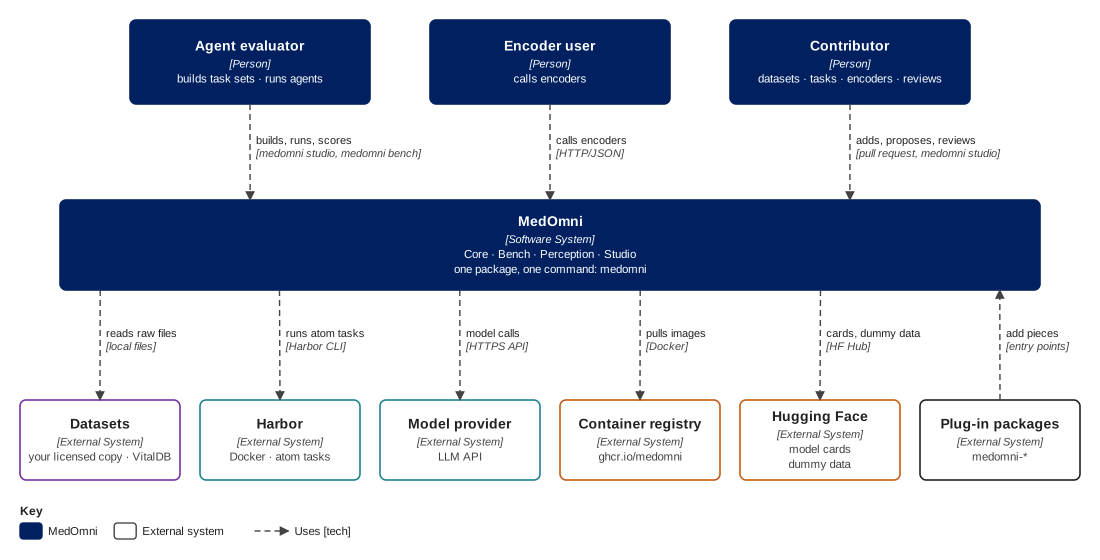
- Agent evaluator: describes an agent, builds a task set from their own data with Studio, runs the agent on it with Bench, reads the scores.
- Encoder user: calls the encoders through Perception's gateway.
- Contributor: adds an agent, a dataset, a task or an encoder through its extension point, and proposes and reviews tasks in Studio.
- MedOmni: one package with one command, holding Core, Bench, Perception and Studio.
- Plug-in packages: outside
medomni-*packages that add agents, datasets, tasks or encoders without a pull request. - Datasets: MIMIC-IV, AI-READI and BDSP under your own license, and VitalDB, read from local disk.
- Harbor: the agent-evaluation framework that runs each atom task in Docker.
- Model provider: the API behind an agent's model on a
cloudroute. Alocalroute needs none. - Container registry: where
medomni perception pullpulls encoder images from (ghcr.io/medomni). Nothing is published there yet; images are built on your machine. - Hugging Face: model cards, and dummy data for each dataset. No real record is published there.
Containers (C2)
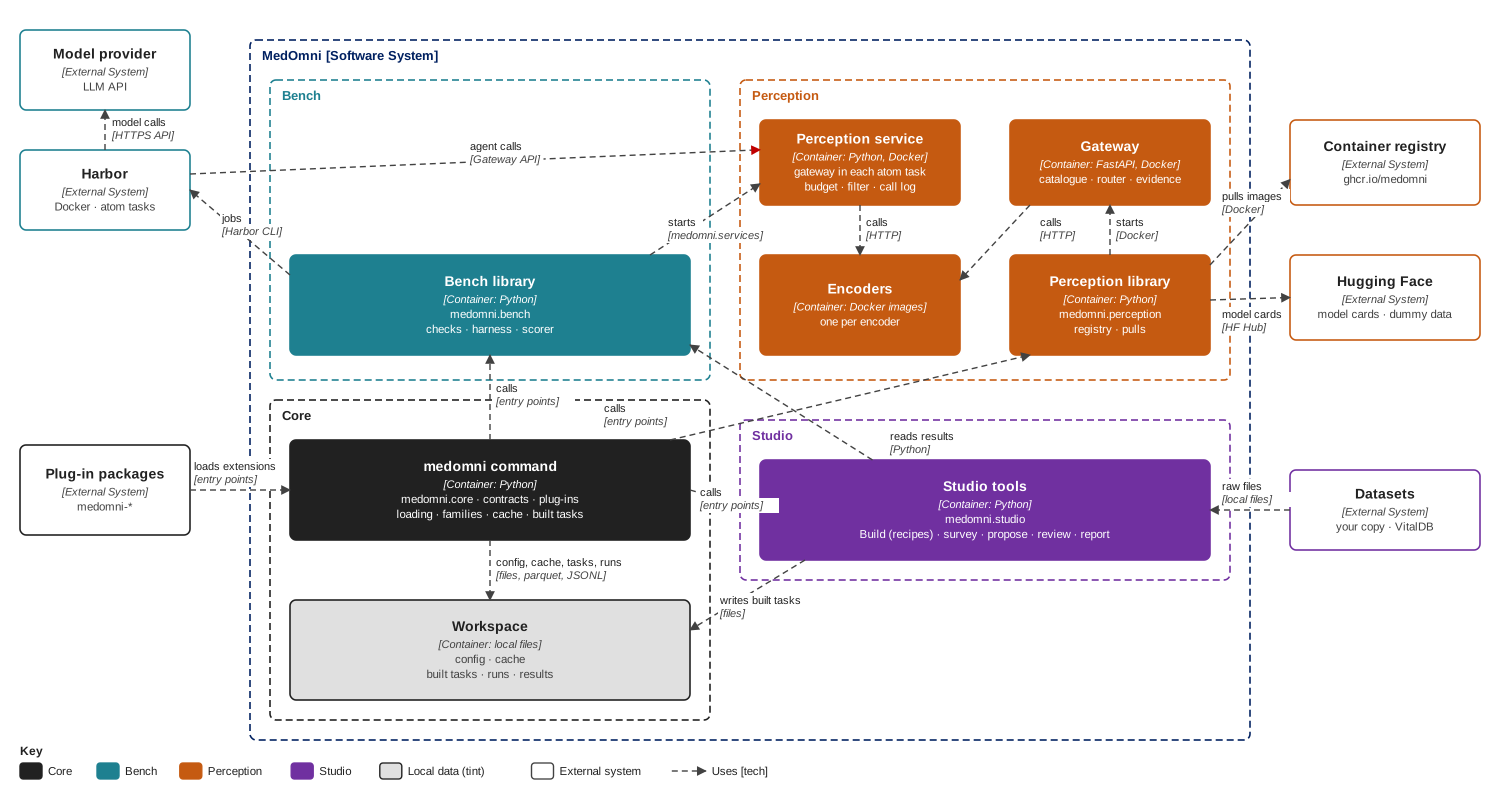
| Container | Project | Does |
|---|---|---|
medomni command |
Core | The entrance: finds the projects through entry points and the plug-in packages' content folders and entry points, then hands each subcommand to its project. |
| Workspace | Core | Configuration, the cache, built atom tasks, the run folders and the results file, on your machine. Never committed. |
| Bench library | Bench | Checks built tasks, turns a task set into Harbor jobs, records runs and scores them. |
| Perception service | Bench | Runs inside each atom task with encoders: Perception's gateway, with Bench's call budget, family filter and call log. |
| Perception library | Perception | Builds and checks encoder images, and starts the gateway. |
| Gateway | Perception | The HTTP service in front of every encoder: its catalogue finds encoders and serves model cards, its router sends each call to a running encoder container. |
| Encoders | Perception | One image per encoder, each reading one family. Built on your machine; model cards on Hugging Face. |
| Studio tools | Studio | Build atom tasks from your data with the medomni-v1 builder, survey datasets, collect and review task proposals, preview cohorts, run the audit and report results. |
Gateway and encoder images are tagged with the MedOmni release that built them. The gateway runs any encoder image built since the Container API last changed.
Components of the package (C3)
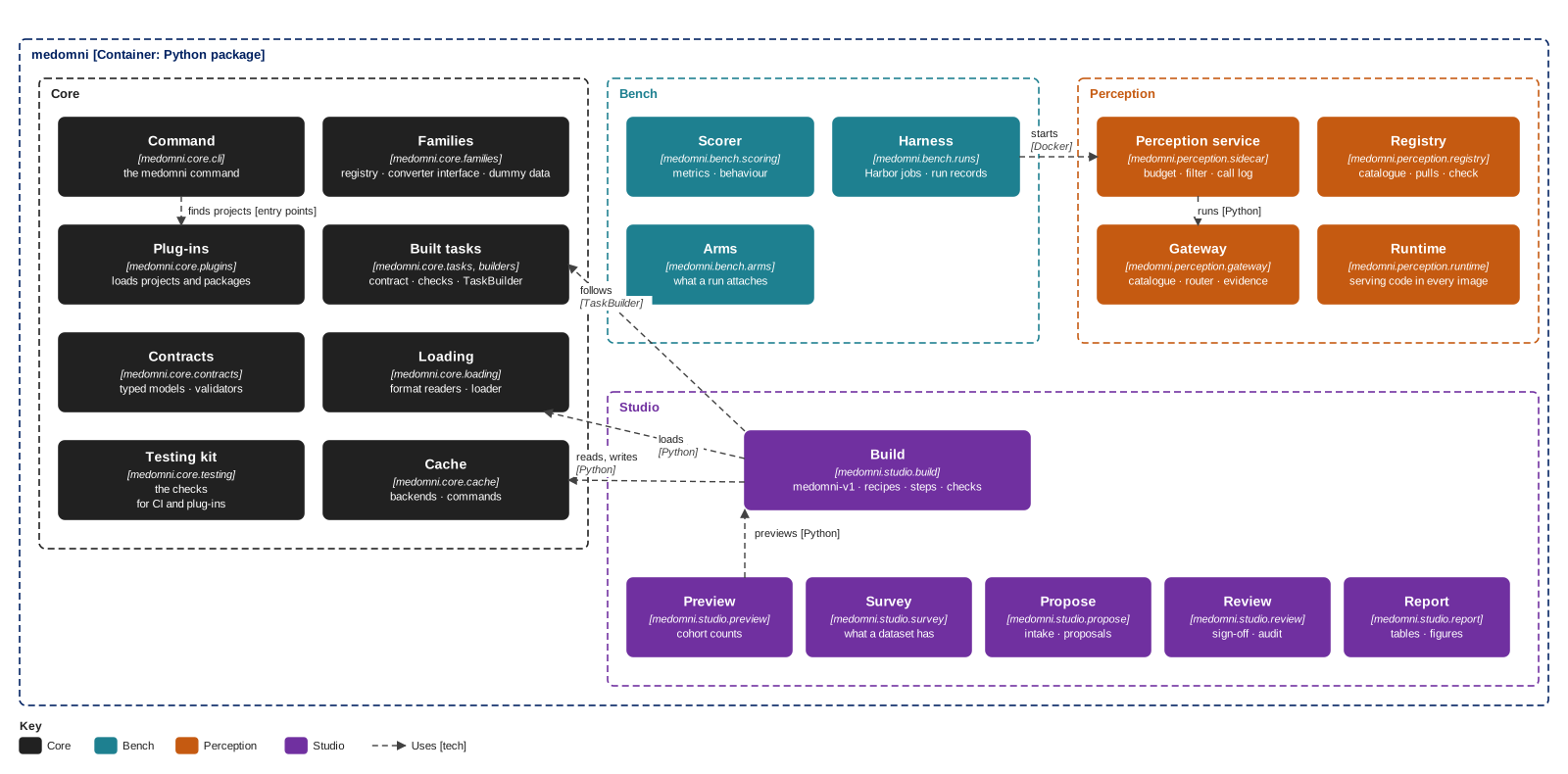
| Project | Component | Module | Does |
|---|---|---|---|
| Core | Command | medomni.core.cli |
The medomni command. Finds each project's subcommands through entry points; see Commands. |
| Core | Contracts | medomni.core.contracts |
The versioned formats, each with a typed model and a validator. See Contracts. |
| Core | Plug-ins | medomni.core.plugins |
Finds the projects' entry points, and the plug-in packages' content folders and entry points. |
| Core | Testing kit | medomni.core.testing |
Runs the checks each project registers. Plug-in packages import it for their own CI. |
| Core | Loading | medomni.core.loading |
The format readers, and the loader that runs a dataset package through them into its event table. |
| Core | Families | medomni.core.families |
The family registry, the converter interface and the dummy-data generator. |
| Core | Cache | medomni.core.cache |
The cache backend call, the folder and none backends, and the cache commands. See Cache. |
| Core | Built tasks | medomni.core.tasks, medomni.core.builders |
The atom layout, task sets, the checks on built tasks, and the TaskBuilder interface. See Built tasks. |
| Bench | Harness | medomni.bench.runs |
The agent runner: turns a task set into Harbor jobs and records runs and prediction records. |
| Bench | Arms | medomni.bench.arms |
The run side of the four built-in arms. The harness looks up any arm by its registered name. |
| Bench | Scorer | medomni.bench.scoring |
Scores complete tasks from their prediction records, one score record per target. The only thing that writes scores. |
| Perception | Gateway | medomni.perception.gateway |
The gateway service, built into the gateway image. |
| Perception | Registry | medomni.perception.registry |
The encoder catalogue: model cards, images, pulls and the encoder check. |
| Perception | Perception service | medomni.perception.sidecar |
The gateway beside each atom task's agent, with the call budget, family filter and call log. Bench starts it through medomni.services. |
| Studio | Build | medomni.studio.build |
The medomni-v1 builder: its recipe format (task templates, cohorts, labels, evidence) and the engine that runs recipes into atom tasks, with the arms' build side and config hashes. See Build. |
| Studio | Tools | medomni.studio |
One subpackage per tool kind: survey, propose, review (with the audit), preview, assets, report. |
The projects meet in contracts: Studio's builder writes built tasks that Bench reads, and Bench starts Perception's perception service through the medomni.services entry point and talks to it only through the Gateway API. Bench imports no Perception code and no Studio code.
Contributors and plug-in packages add agents, datasets, tasks and encoders to the projects; Extend MedOmni lists each extension point with its template and check.
How Core finds the projects
Core is the medomni command and the shared machinery. It imports no project; each project tells Core what it adds, through entry points in MedOmni's own pyproject.toml:
- its subcommands, such as
medomni bench …, inmedomni.commands - the checks behind its check commands, and its audit checks, in
medomni.checks - its content kinds, each a folder pattern and its contract, such as
studio/datasets/*/dataset.yaml, inmedomni.content - a service a run starts beside the agent, such as Perception's perception service, in
medomni.services
This is internal wiring, done once per project. Users never do it; a later project joins the same way. Outside packages that add pieces use plug-ins instead.
All levels
Where next
- Design principles: the principles behind this layout.
- Reference: the contracts each project reads and writes.
- Commands: every subcommand.